Special Purpose Machines
Standard Pack-Out Machine Design for Injection Molded Parts
The customer is a US-based industrial automation and robotics company specializing in food robotics, machine vision, track-and-trace systems, pick-and-place solutions, and related technologies. The company serves customers across global markets.
Scope
The client required us to design and develop a compact standard pack-out machine at the rear of an injection molding machine to handle and pack molded parts through a conveyor system. The scope included:
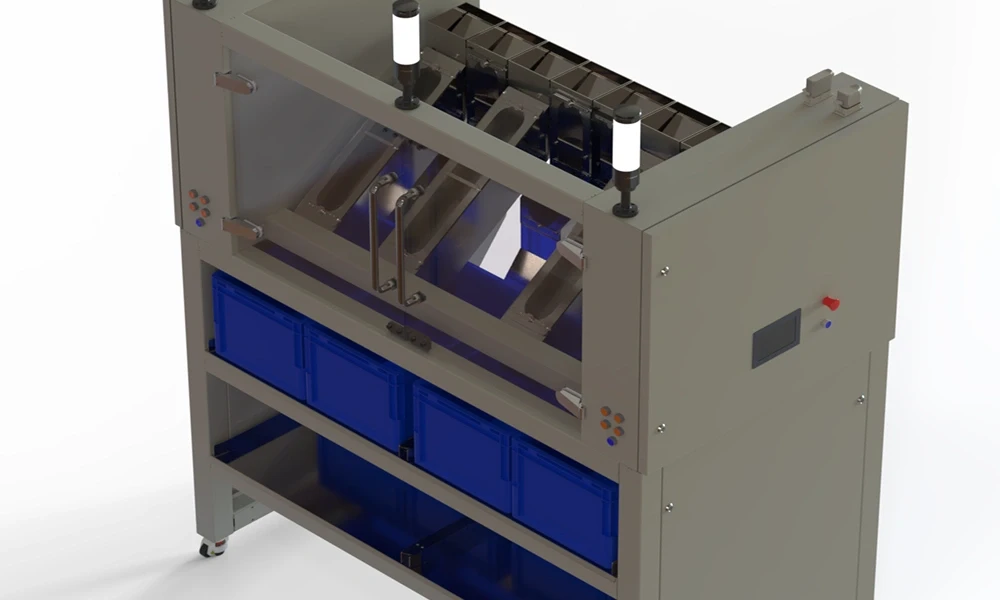
- 8 chute assemblies to distribute parts into 8 tote bins (trays)
- Compact layout to fit within the size-constrained footprint
- Custom-mounted electrical panel integrated into the machine
- Modular, non-welded frame structure for easy assembly, wire routing, and maintenance

Challenge
Molded parts were transferred from the injection molding machine through a medium-speed conveyor and discharged through multiple chute assemblies. The main challenges were:
- Controlled part flow: Preventing excessive acceleration in the chutes that could damage parts while maintaining a consistent flow.
- Limited footprint: Arranging the tote bins within a tight space without compromising operator access or throughput.
- Non-welded frame: Maintaining structural stability while using a fully non-welded frame and allowing easy cable routing and maintenance.
Solution
Sedin developed a compact pack-out machine for handling injection molded parts, with a focus on controlled part flow, efficient use of space, structural stability, and easy maintenance. The design was developed around the customer's functional, safety, ergonomic, and space requirements.
The design process involved concept development, 3D layout planning, component placement, design reviews, and DFMEA to identify and address potential design issues early.
The key design solutions included:
1. Pack-out machine design for controlled part flow
In injection molding applications, molded parts exit the machine at a steady rate and speed. Controlled downstream handling is important to prevent part damage and maintain a consistent flow. The chute arrangement was designed to guide parts smoothly from the conveyor into the tote bins.
Our engineers:
- Designed 8 chute assemblies to distribute parts into 8 individual tote bins.
- Optimized chute geometry to control part speed and reduce the risk of part damage.
- Ensured smooth and consistent part flow from the conveyor to the tote bins.
2. 3D machine modeling and layout optimization
The machine had to fit within a limited footprint while providing enough space for 8 tote bins, operator access, and maintenance. 3D modeling was used to develop and review the overall machine layout before finalizing the design.
- Developed a two-row arrangement for 8 tote bins to make efficient use of the available space.
- Optimized the position of the chutes, frame, tote bins, and panel mounting arrangement.
- Maintained operator access, visibility, and serviceability within the compact layout.
3. Modular non-welded frame design
The customer required a fully non-welded frame, so the structure had to provide stability while remaining easy to assemble and maintain. A modular sheet-metal frame was developed to meet these requirements.
- Designed a modular, non-welded frame for easy assembly and disassembly.
- Provided provisions for wire routing and cable management.
- Maintained access to key areas for inspection and maintenance.
4. Component mounting and machine integration
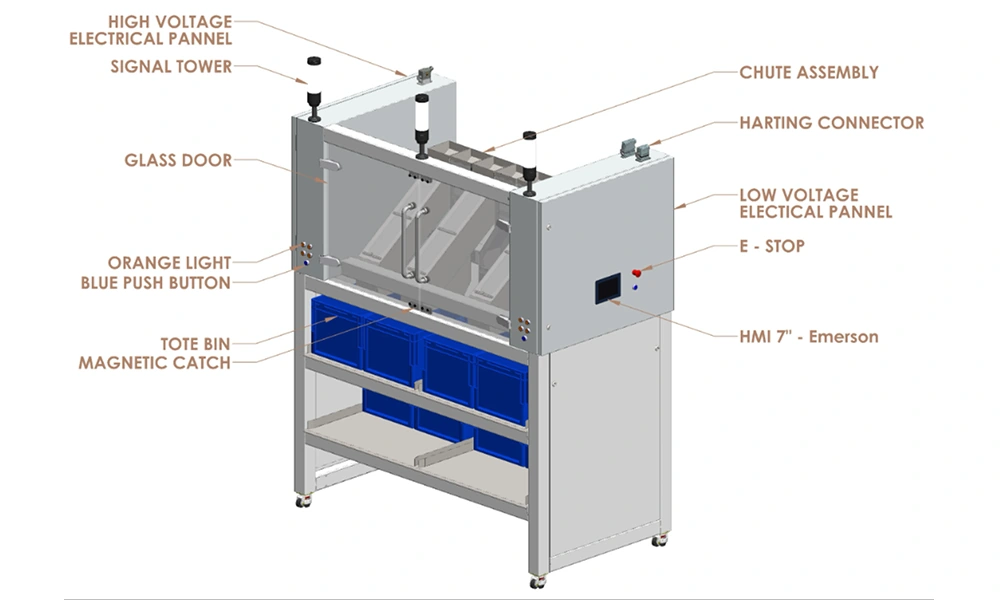
The compact layout required careful placement of the HV and LV electrical panels within the machine frame. The mounting arrangement was designed to make efficient use of space while keeping the surrounding components accessible.
- Designed mounting provisions for the HV and LV electrical panels.
- Positioned the panels within the machine frame to maintain a clean layout.
- Coordinated panel placement with the machine layout and wire-routing requirements.
5. Sensing and operator control
The machine design included provisions for sensing and visual feedback to help operators monitor tote availability during operation.
- Provided provisions for part-presence sensors to confirm tote availability.
- Included visual indicators for clear operator feedback.
- Added a manual reset function for operator control.
6. DFMEA and safety considerations
Potential design risks were reviewed during development using DFMEA. The design also considered the customer's safety and ergonomic requirements along with ISO 12100 principles for machinery risk assessment and risk reduction.
- Used DFMEA to identify and address potential design failure modes.
- Considered operator access, ergonomics, and maintenance during the design.
- Applied relevant ISO 12100 risk-reduction principles during the machine design process.
This design approach helped deliver a compact and maintainable machine that met the customer's functional and space requirements, while demonstrating Sedin's experience in automation machine design services for SPM and material handling applications.
Value and Benefits
Compact pack-out design helped maximize available floor space for injection molded parts handling.
Efficient material handling supported consistent part flow and reliable operation.
Modular design made assembly and maintenance easier.
Practical engineering helped keep fabrication and equipment costs under control.
Sedin’s expertise in special-purpose machines and material handling equipment provided a reliable design partner for the customer.
Related Case Studies


Automated Laser Marking Machine Design
Engineering design of an automated industrial laser marking machine with gantry positioning, fume extraction and batch processing for precise marking.


Rotary Indexing Table Design for Tailgate and Glass Handling
Designed a compact 3-axis rotary indexing table with fixture for safe glass & tailgate handling, helping the client reduce cost and improve productivity


Robotic Drill Cell
Optimized drilling operations for sleeper roof caps with an innovative robotic cell, cutting lead times and ensuring precise, efficient production.